Key Highlights
- Southern California’s aerospace sector is seeing a fresh wave of growth driven by automation and AI.
- Companies like Freeform, First Resonance, and Machina Labs are expanding operations.
- Industry leaders say scaling physical manufacturing remains one of the biggest challenges.
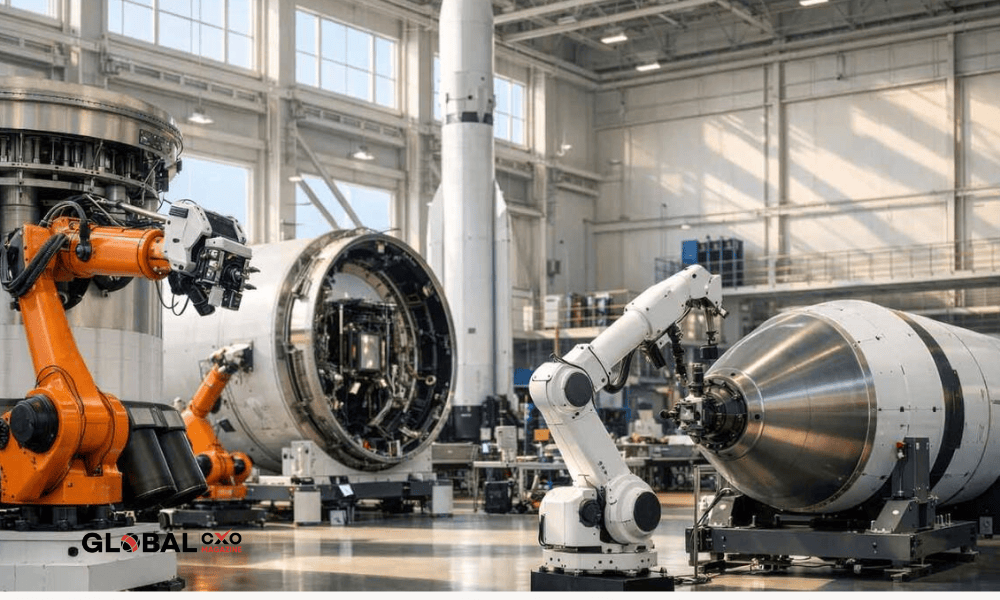
Southern California’s aerospace and defense manufacturing sector is seeing renewed momentum, with automation becoming a major focus as companies look to speed up production and meet rising demand.
The region continues to benefit from government spending, venture capital funding, and a growing pool of engineering talent, all helping push new technologies into the sector.
For companies building in the physical world, the conversation is increasingly centered on removing old manufacturing bottlenecks.
“We make things for customers that couldn’t exist before,” said Freeform co-founder and CEO Erik Palitsch. “The manufacturing system is antiquated. AI doubles every nine months, but the physical world isn’t keeping up.”
Startups Bet on Faster, Smarter Production
El Segundo-based Freeform recently raised $67 million in a Series B round to expand manufacturing and push automation further. That funding brings the company’s total raised capital to $179 million.
Palitsch, who previously worked at SpaceX as an engineer, said the company has built its own printers, software, and factory systems to scale metal-printed parts for both defense and commercial sectors.
He said the future factory will look very different from traditional manufacturing.
“There won’t be a big warehouse with operators and punch cards,” Palitsch said. “Customers will upload a part, and everything downstream will be manufactured autonomously within the next 12 months.”
While automation is speeding up production, software is becoming equally important.
First Resonance, also based in El Segundo, works with nearly 100 customers and focuses on helping manufacturers track workflows, supply chains, and compliance requirements.
“We are focused on the ability to meet capacity and scale operations,” said Karan Talati. “It’s easy to build one of anything, but it’s really hard to build 1,000.”
Talati said aerospace manufacturing still involves a heavy amount of paperwork, much of it done manually, which slows teams down.
Meanwhile, robotics company Machina Labs is also expanding after raising $124 million earlier this year to open a 200,000-square-foot factory.
Its CEO Ed Mehr said manufacturing in the U.S. still faces a cost challenge, especially in defense.
“If we do things right, we will bring the cost down,” Mehr said. “But it only happens if we expand capacity.”